Pitch · AI wearable + software
Tuck
In your pocket. On your side.
The film. A design concept. Renders are illustrative only.
Music: “Our World” by Rezident feat. Elmar.
Every AI gadget so far wants a spot on your body. A pin. A pendant. A pair of glasses. Tuck goes in the one place you already carry everything: your pocket. It's a flat strip of eight hinged tiles, thinner than a phone case. It rides along the pocket wall, stays out of the way, and comes up the moment you need it.
Wearables. Nearables. Now, Awayables. AI you carry that stays out of your way.
Tuck it away. It stays out of your way. Pull it out. It works there too.
In one sentenceTuck is a voice assistant that lives in your pocket. It hears you through the fabric, your phone and the cloud do the heavy thinking, and it moves only when moving helps.
The device
A flat strip of eight hinged tiles with a camera, mics, battery and seven tiny motors. It lives in your pocket and moves when it helps.
What's inside ↓ Part 2 · SoftwareThe Gait Lab
A physics simulator that tests different ways for Tuck to walk, races them against each other and evolves the fastest, most efficient one.
Open the Gait Lab →What it does
- 01
Stays out of the way
Tuck shares your pocket without crowding it. It can lie stretched out flat along one wall, thinner than a phone case. Or it opens into a ring and presses against the walls near the top, which is how it holds its place. Either way, keys, cards and coins drop straight past it to the bottom. It never takes the room you need.
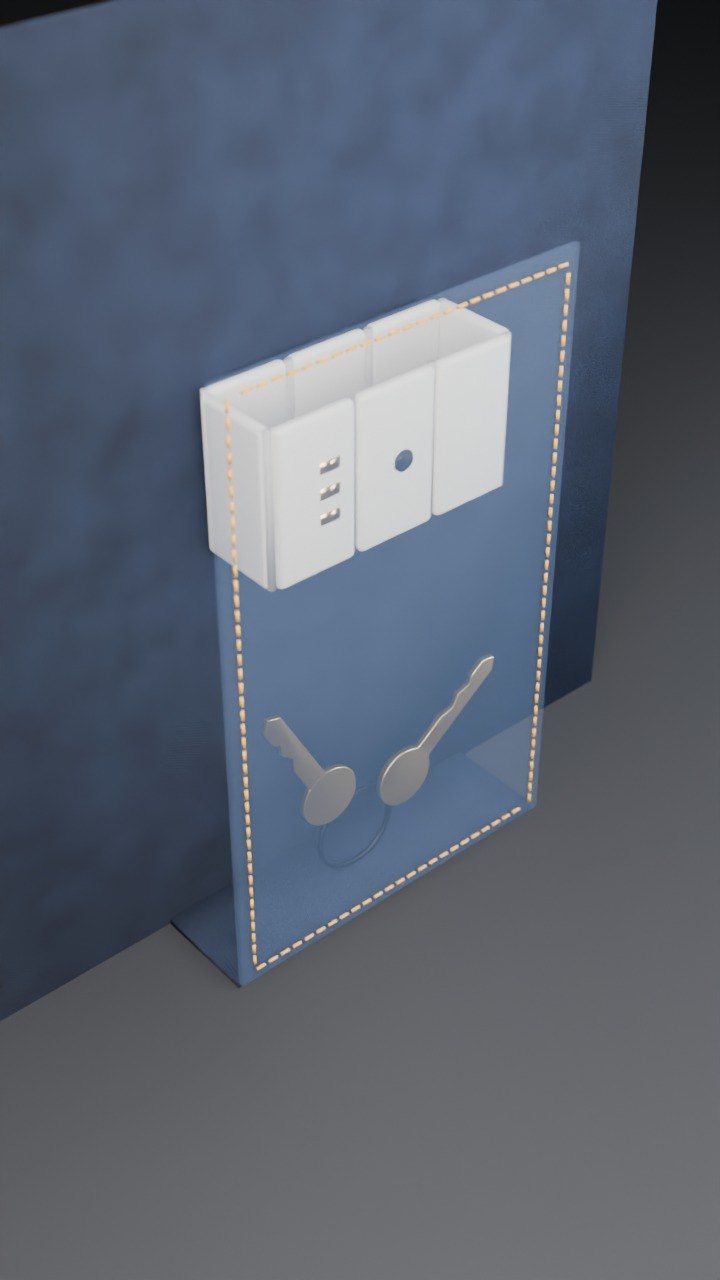
The ring, pressed against the walls. Keys fall past. - 02
Taps your leg
A separate trick. Tuck notices what usually rides in your pocket. Heading out without your keys? It gives your leg a gentle double tap from inside the pocket. No screen to check. You just feel it.
- 03
Comes up when called
Say its name and the tip tile, the one with the eye, rises out of the pocket so it can see what you see.
- 04
Works out of the pocket too
Pull it out and set it down, and it folds into a stand, level, with the eye facing you. A tiny tripod that's also the assistant.
- 05
Walks and rolls
Call it over and it inches across the table like an inchworm. Seven hinges, one smooth stride. In a hurry, it closes into a ring and rolls.
- 06
Covers its eye
Want privacy? It folds over its own eye, so everyone can see it's off. Privacy you can check at a glance.
What's inside
Every tile has a job. The heavy parts sit in the middle so it balances when it stands.
Eye tile (the tip)A tiny camera, two microphones and a light sensor. It's the tile that rises out of your pocket, so it's the one that can see and hear best.
Voice tileA thin speaker for short replies and a haptic buzzer. For longer answers it talks through your earbuds.
Brain tileA low-power chip that runs the motors and Bluetooth, plus a wake-word chip that listens for its name on a fraction of a milliwatt.
Four battery tilesOne thin pouch cell in each, wired together. The middle of the strip is the battery.
Seven hinge motorsA 3 mm micro gearmotor and an angle sensor at every joint. They tap, lift, stand, walk and fold.
Grip pads on both endsElectroadhesive pads that grip only when switched on, which is what makes the inchworm walk work. The tail tile also carries three magnetic charging contacts.
What powers it
Four thin lithium polymer cells, about 2.5 mm thick, one in each middle tile. Together that's roughly 3 watt-hours, about 800 mAh. That's more than a smartwatch carries, because the battery is spread along the whole strip instead of stacked in one lump.
| Doing | Power draw (estimate) | Lasts |
|---|---|---|
| Waiting and listening for its name | about 2 to 3 mW | weeks |
| Talking with you, streaming to your phone | about 60 to 100 mW | a day or more |
| A camera glance | about 0.4 W, for a few seconds | hundreds of looks |
| Moving: tapping, standing, walking | about 0.5 to 1.5 W | 2 to 4 hours of motion |
Moving is the expensive part, which is why Tuck mostly sits still and moves in short bursts. A normal day of listening, talking and a few minutes of moving should use well under half a charge.
Charging: the three contacts on the tail tile snap magnetically onto a small USB-C puck or a desk dock. Leave it there overnight like a watch. About an hour from empty to full.
These are rough engineering estimates from current off-the-shelf parts, not measurements from a prototype.
Where the AI lives
1 · Tuck hears
The wake-word chip listens for its name, and nothing leaves the device until it hears it.
2 · Your phone thinks
Tuck streams your voice, and a camera frame when you ask, over Bluetooth to an app on your phone. The phone sends it to whichever AI model you use.
3 · Tuck answers
The reply comes back as speech in your earbuds or from the voice tile, or as a motion: a tap, a rise, a stand.
That split keeps Tuck thin and cool. The heavy computing happens on hardware you already carry, and your phone stays in your bag. And when it's folded shut over its eye, the camera is physically covered.
Why this shape
Every part is there for a reason.
200 × 46 × 3.6 mm overall.
Tested in physics
A walking strip sounds easy until you try it. So I built a physics model of Tuck: eight rigid tiles, seven motorized hinges, gravity and real sliding friction. On a plain underside, the inchworm gait slips in place. The hinges move, but the friction cancels out. Add grip that only holds in one direction and it crawls right across the table.
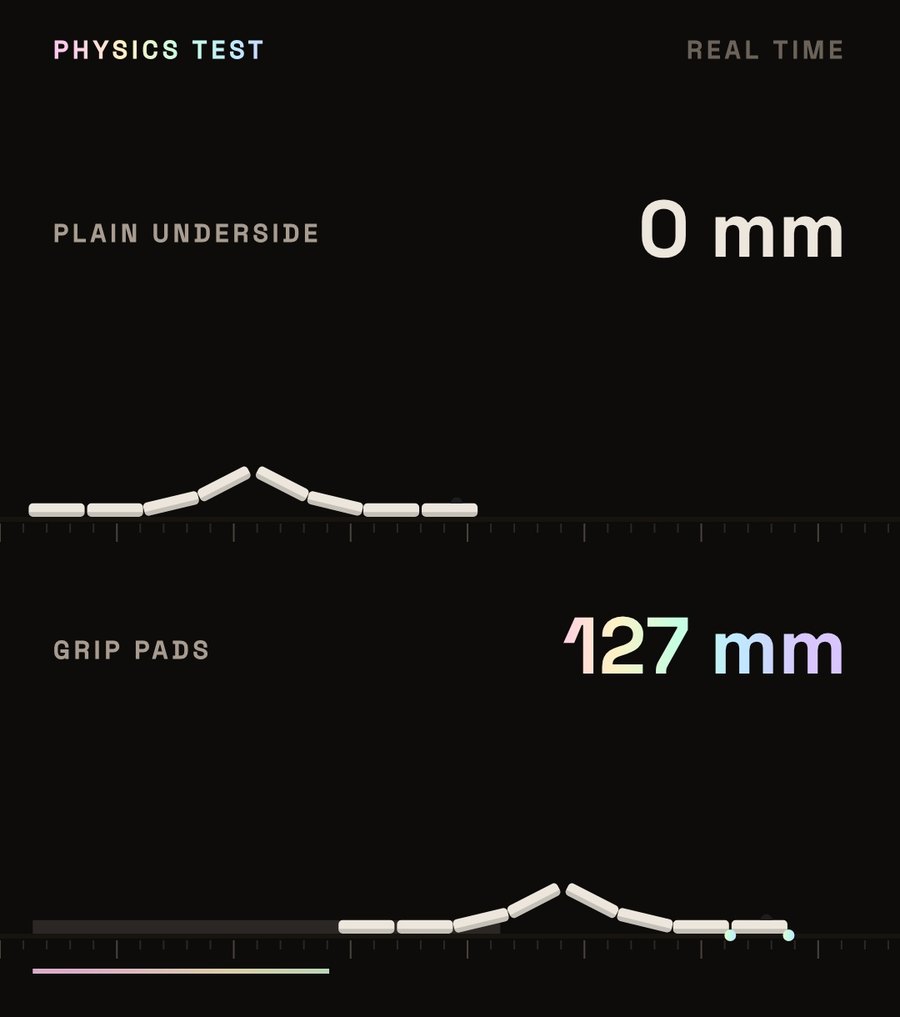
That's a real design rule, not a styling choice. Tuck needs switchable end pads or a directional texture on its back.
Then I built a second tool, the Gait Lab, to find the best walk instead of guessing. It runs a whole population of walking recipes in the same physics, keeps the fastest, breeds and mutates them, and repeats. Each round, the walk gets smoother and uses less energy. Next, AI models take over the training, so Tuck learns to move around the way a living thing would.
Pick a skin
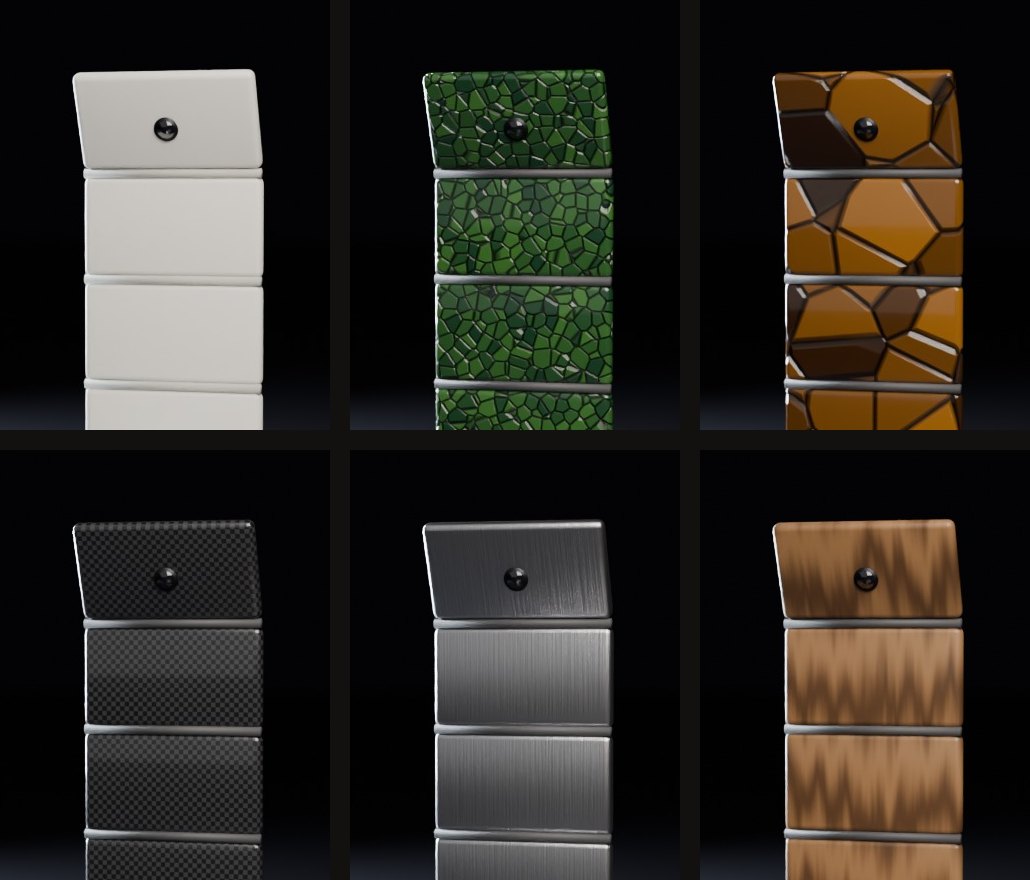
Bone, reptile, turtle shell, carbon, titanium, walnut. Same tiles, swappable faces, so it can look like jewelry, a tool or nothing at all.
What's known
- The geometry works. One strip of straight hinges reaches every pose in the film: flat, ring, stand, walk, roll and fold.
- The crawl needs one-way grip. The physics model shows it clearly.
- It fits. The ring sits against the walls of a jeans pocket and leaves the middle clear.
What needs testing
- Torque. Standing up means lifting about half the strip from the bottom hinge, roughly 9 mNm. A 3 mm gearmotor gives under 1 mNm, so each hinge needs an extra gear stage. Slower, but workable.
- Thickness. 3.6 mm is the goal. With 2.5 mm cells, a 3 mm motor and a shell, the first prototype will more likely be around 5 mm.
- Hearing through fabric. Denim muffles high frequencies. The eye tile sits at the top for a reason.
- Rising out of a tight pocket every time, without snagging.
- Grip pads on real surfaces: wood, glass, a car dashboard.
- Wear, heat and cost.
Who's behind it
I'm Joshua Logan, a magician and mentalist. I perform for Apple, Google, Meta and OpenAI, and I teach at the Magic Castle. I studied perceptual psychology at UC Davis, and I make AI films and tools. Magic taught me that the best technology disappears until the exact moment it matters. That's Tuck.
Next step
Build one test strip. Eight tiles, real hinges, a battery and a microphone. Then three questions: does it hold its place in a real pocket, can it rise on command, and does it walk on a real table? Everything else is built around those answers.
Talk about it